
AlUla vs Petra: Two Nabataean Wonders Compared
Two thousand years ago, the same civilisation built extraordinary stone cities in two different places. Both were carved from rose-coloured sandstone. Both served as commercial and spiritual centres for one of the ancient world's most sophisticated trading empires. Both were abandoned and forgotten, then rediscovered centuries later. The Nabataeans built Petra (in modern Jordan) and Hegra (in modern Saudi Arabia). For the first time in history, both are now accessible to international luxury travellers. The question is: which to visit first?
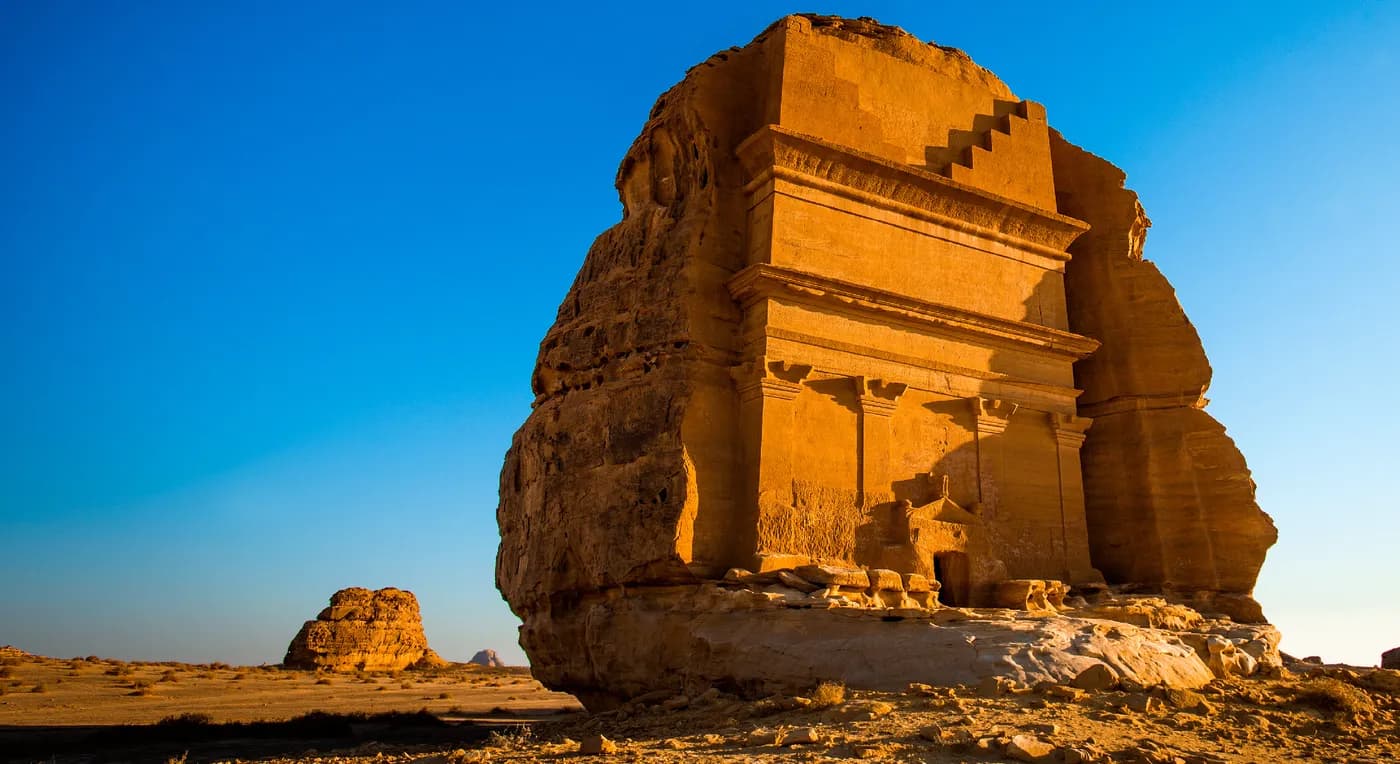 Hegra (Mada'in Salih), AlUla, Saudi Arabia
The Shared History
The Nabataeans were an Arab trading civilisation based in the northwestern Arabian Peninsula and southern Jordan, sophisticated engineers, astronomers, and merchants whose territory stretched from the Hejaz to the Mediterranean. They controlled the trade routes that carried frankincense, spices, silk, and gold between Arabia, Africa, India, and the Greco-Roman world. Their architectural signature, monumental facades carved directly into sandstone cliff faces, with elaborate entablatures, urns, and cornices drawn from Greek, Roman, and Egyptian influences, is instantly recognisable at both sites.
Petra was the Nabataean capital; Hegra was its second city, the southern anchor of the trade route. Both were abandoned following the Roman annexation and eventual collapse of the long-distance trade networks that sustained them. Petra was"rediscovered" by a European explorer in 1812; Hegra was identified and studied in the 19th century but remained almost entirely closed to visitors until Saudi tourism opened in 2019.
The Critical Difference: Solitude
Here is the honest comparison that no travel article about Petra will tell you: in 2026, Petra receives over a million visitors per year. On a typical day, the Siq, the narrow canyon approach to the Treasury, is dense with tour groups, hawkers, and souvenir stalls. The Treasury itself, Petra's iconic facade, is so constantly photographed that individual moments of stillness require either very early morning access (before tours arrive) or considerable patience.
Hegra received approximately 200,000 visitors in all of 2023, its first full year of operation. In practice, this means that during a private after-hours tour, you will have 111 Nabataean tombs and 3.75 square kilometres of archaeological site entirely to yourself. The silence is absolute. The scale is fully apparent. You can stand at the entrance to the Qasr al-Farid, the largest tomb at Hegra, carved for a single occupant and left incomplete at their death, and have no other person within your field of vision.
This is not a permanent advantage. As Saudi Arabia's tourism programme accelerates, visitor numbers at AlUla will grow. But right now, Hegra offers something that Petra cannot: the complete experience of a UNESCO World Heritage site without the crowds that world heritage status usually brings.
AlUla / Hegra
- - Saudi Arabia's first UNESCO World Heritage Site (2008)
- - 111 monumental tombs across 3.75 sq km
- - Currently very low visitor numbers vs Petra
- - Private after-hours access available
- - Exceptional luxury hotels on site (7 properties)
- - The broader AlUla landscape adds significant value
- - Best combined with Red Sea resort stay
Petra, Jordan
- - UNESCO World Heritage Site (1985)
- - The Treasury, Street of Facades, Monastery
- - Over 1 million visitors per year
- - Early morning access helps; solitude rare
- - Luxury accommodation improving but limited
- - The scale and grandeur remains extraordinary
- - More accessible from Europe as a standalone trip
The Luxury Accommodation Comparison
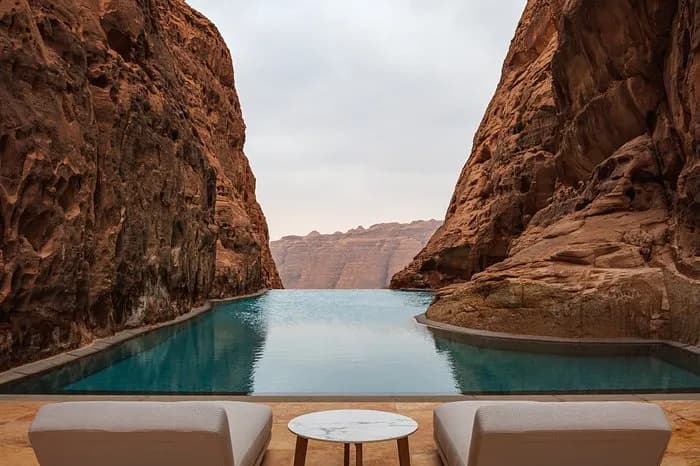 Banyan Tree AlUla: desert villas with canyon views
Petra's luxury accommodation has historically been its weakest point. The best options, the Mövenpick Resort Petra and the Petra Marriott, are good hotels, but they do not approach the level of AlUla's offering. AlUla has Banyan Tree (private canyon-edge plunge pool villas), Six Senses Southern Dunes (transformative wellness), The Chedi (Zen minimalist design), and Habitas (community-driven desert luxury). All four properties are purpose-built for the desert environment, architecturally integrated into the landscape, and operating at genuine luxury standards.
The combination of the heritage experience and the quality of the accommodation is, frankly, not comparable. AlUla wins this dimension decisively.
The Verdict
Both AlUla and Petra are extraordinary. Both deserve to be visited. They are, in the fullest sense, wonders of the ancient world. But if you have to choose one first, and if luxury is your priority, AlUla in 2026 has a clear advantage: the combination of archaeological significance, solitude, and accommodation quality is not available anywhere else in the world.
Visit AlUla now, while the crowds have not arrived. Petra will still be there, and it will still be magnificent, when you go later. The window of experiencing a UNESCO World Heritage site in near-complete solitude, at the highest level of luxury, is finite. We have been saying this since AlUla opened, and we will keep saying it: this is the trip that will not exist in this form in ten years.
Book AlUla's Finest Hotels
Banyan Tree AlUla
Canyon-edge villas · Editor's Choice
Book Banyan Tree AlUla
Check availabilityOr book direct with
We compare 4 sites at no cost. Same price as booking direct.
Six Senses Southern Dunes
Wellness dune retreat
Book Six Senses Southern Dunes, AlUla
Check availabilityOr book direct with
We compare 4 sites at no cost. Same price as booking direct.
The Chedi AlUla
Zen sandstone minimalism
Book The Chedi AlUla
Check availabilityOr book direct with
We compare 3 sites at no cost. Same price as booking direct.