2026 Luxury City Guide
Riyadh
Saudi Arabia's capital combines palatial luxury hotels with the Edge of the World escarpment, UNESCO-listed Diriyah, a 1,300-year arc of history in Al-Masmak, and a dining scene that now rivals any major city in the region.
The City
Understanding Riyadh as a Luxury Destination
For most of the twentieth century, Riyadh was understood primarily as a seat of government, a city of consequence rather than of beauty. That characterisation has always been incomplete, and it is now comprehensively obsolete. The capital of Saudi Arabia is in the middle of the most ambitious urban cultural project of any major city in the world, and the results, already visible across the museum landscape, the restaurant scene, the private arts circuit, and the hotel portfolio, suggest that Riyadh is becoming a genuinely compelling destination for travellers who pay attention.
What has not changed, and what provides the city's most extraordinary contrast, is the landscape that surrounds it. Ninety minutes in any direction, the urban grid gives way to the Arabian Peninsula in its geological and historical form: the Tuwaiq Escarpment, the Wadi Hanifah, the ancient mudbrick ruins of Diriyah, the undifferentiated emptiness of the central desert. The Edge of the World, where the plateau simply ends, hundreds of metres above an uninhabited valley, is a twenty-first century luxury experience that happens to be geologically ancient, reached from the Ritz-Carlton in a 4WD and best enjoyed at the cliff edge at sunset. The combination is precisely what makes Riyadh worth the journey.
A rewarding stay in Riyadh runs to around five nights: time for culture and the old city, for Diriyah, for the Edge of the World, and, for many travellers, an onward leg to AlUla, where the Nabataean ruins that the National Museum contextualises become real. The best months to visit are October through April, when temperatures are mild and the cultural calendar is at its most active. This is the Kingdom at its most complete, and it begins, appropriately, in its capital.
Landmark Sites
Riyadh's Defining Destinations
Five places that together constitute an argument for Riyadh as one of the most layered, and most underestimated, luxury destinations in the world.
Natural Wonder
The Edge of the World - Jebel Fihrayn
Ninety minutes from the centre of one of the world's most modern cities, the Tuwaiq Escarpment ends in a sheer vertical drop of several hundred metres. The plateau simply stops, and below it, extending to the horizon, is an entirely uninhabited valley that has not materially changed in ten thousand years. There are no barriers, no crowds, and no infrastructure. You stand at the edge of the Arabian Peninsula's geological spine and look out at something that genuinely earns the designation wonder.
The best time to arrive is approximately one hour before sunset. The light at this point is extraordinary, warm, raking, the kind of illumination that makes the canyon walls glow red and gold simultaneously. Private chef, champagne and mezze services at the cliff edge are available through local operators, at viewpoints far enough from the most accessible ledges to have the escarpment largely to yourself yet close enough that the scale is fully apparent.
The return journey in darkness, with the Riyadh skyline emerging from the desert on the horizon, underlines something that Riyadh's most intelligent visitors understand immediately: this city exists in extraordinary proximity to a landscape of geological antiquity. That juxtaposition, glass towers above, ancient emptiness below, is one of the defining experiences of contemporary Saudi Arabia.
UNESCO World Heritage
Diriyah & At-Turaif UNESCO Heritage
In 1727, on a bend in Wadi Hanifah fifteen minutes from what would become central Riyadh, a walled city was built from the distinctive mudbrick of the Najd region. At-Turaif became the capital of the first Saudi state, a centre of religious authority, trade, and political power whose influence extended across the entire Arabian Peninsula. When it fell in 1818, its ruins were simply abandoned where they stood. They remain there today, in a state of extraordinary preservation, protected as a UNESCO World Heritage Site.
A private evening tour of At-Turaif, led by a specialist historian, is among the most atmospheric experiences in the Kingdom. The ruins are illuminated at night, the mudbrick walls rising four storeys against a dark sky, the wadi below carrying the sound of flowing water through a landscape of palm groves. A knowledgeable guide contextualises each structure: the palace of the Imam, the great mosque, the merchant quarters, the defensive towers that once repelled Ottoman incursion.
Beyond the ruins themselves, the wider Diriyah development is transforming the valley into one of the region's great cultural destinations. The Bujairi Terrace, overlooking the UNESCO site from the opposite bank, now hosts a concentration of fine dining and cultural spaces whose quality would distinguish any city in the world. A private dinner here, with the illuminated ruins across the wadi, closes the day in a manner that is difficult to improve upon.
Architectural Icon
Kingdom Centre Tower & Sky Bridge
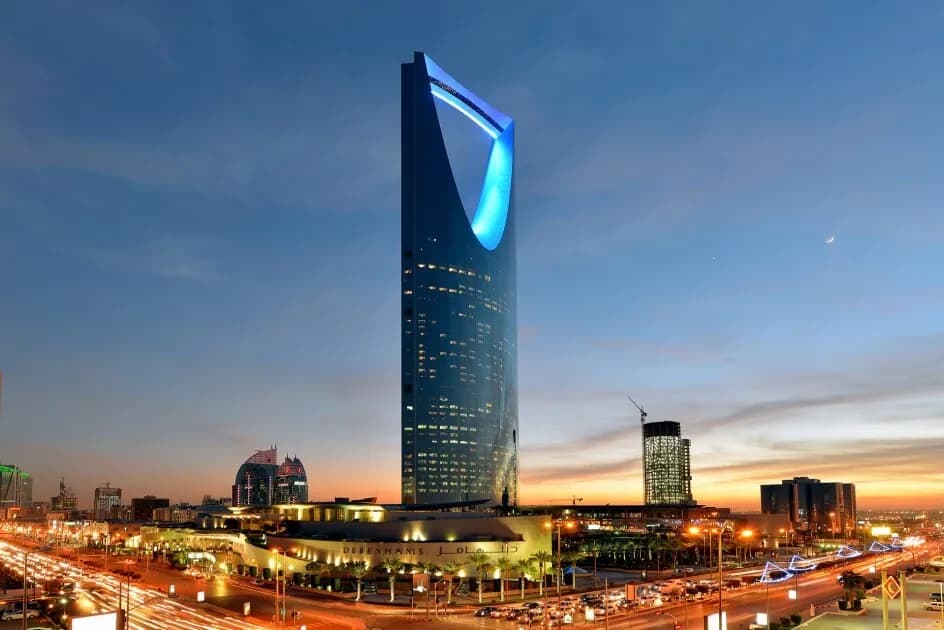
The Kingdom Centre is not simply the tallest building in Saudi Arabia. It is one of the most architecturally distinctive skyscrapers on earth. Designed by Ellerbe Becket and completed in 2002, its defining feature is a 65-metre sky bridge connecting the two sides of the tower at its apex, forming an inverted parabolic arch that is visible from much of Riyadh. The Four Seasons occupies floors 30–39; the Sky Bridge observation deck sits at 99.
Private access to the Sky Bridge, outside of peak visiting hours, offers 360-degree views across a city that, seen from this altitude, resolves into one of the most extraordinary urban landscapes in the world: a dense modernist grid extending to the desert in every direction, punctuated by the unfinished ambitions of Vision 2030 construction. On a clear winter day, the horizon is visible for 60 kilometres.
The Kingdom Centre mall, occupying the building's lower levels, houses the most concentrated collection of international luxury retailers in Saudi Arabia, Cartier, Bulgari, Hermès, Dior, alongside a private shopping experience programme that can be arranged with individual boutiques outside of retail hours for guests who prefer their commerce without the attendant audience.
Cultural Institution
National Museum of Saudi Arabia
The National Museum of Saudi Arabia, adjacent to the Murabba Palace at the centre of the old city, is the definitive account of a civilisation that predates Islam by tens of thousands of years and that the outside world is only beginning to understand. Spread across eight thematic galleries, the museum traces the full arc: from Neolithic settlement through the Nabataean civilisation that built Hegra (the same culture responsible for Petra), through the emergence of Islam and the formation of the modern Saudi state.
What distinguishes a private tour, led by a senior academic with specialist knowledge of the pre-Islamic collections, is not merely the absence of other visitors but the depth of conversation it enables. The Nabataean section alone warrants two hours; the relationship between the archaeological finds here and those at Hegra in AlUla is a thread that, once pulled, reframes an entire Saudi itinerary.
For travellers who intend to visit AlUla, the National Museum makes an ideal first chapter, an intellectual foundation that transforms what might otherwise be a photogenic rock formation into a living culture with a traceable story. The combination of Riyadh's museum and a private archaeological tour of Hegra is one of the most intellectually complete experiences Saudi Arabia offers.
Historic Landmark
Al-Masmak Fortress
Al-Masmak Fortress is where modern Saudi Arabia began. In 1902, a 22-year-old Abdulaziz ibn Saud led a small raiding party through the pre-dawn streets of Riyadh, stormed this mudbrick fortress, and recaptured his family's ancestral home from a rival clan. The door of the fortress still carries the spearhead that was thrown at the retreating governor in the final moments of the battle, embedded in the timber where it landed.
Now a museum administered by Riyadh's cultural directorate, Al-Masmak is a remarkably intimate building, its walls are thick, its rooms low, its courtyard used for public recitation and small concerts in the evenings. A private visit, with a historian who can narrate the specific events of January 15th 1902 room by room, transforms it from a heritage site into a genuine drama. This was the opening act of a state that now stewards the holy cities of Islam and is one of the most significant economies on earth.
The surrounding Dira Souq, immediately adjacent, is one of the most atmospheric traditional markets in Riyadh, gold dealers, spice merchants, and textile sellers in a covered market whose character dates from the same period as the fortress itself. A guided morning walk through both sites, ending with a traditional Saudi breakfast in a nearby coffee house, is among the most grounding experiences the city offers.
Where to Stay
Riyadh's Two Premier Properties
The choice between the Ritz-Carlton and the Four Seasons is a choice between two entirely different philosophies of luxury, palace versus eyrie, both executed at the highest possible standard.
Palace Luxury
The Ritz-Carlton, Riyadh
Al Hada District, Riyadh
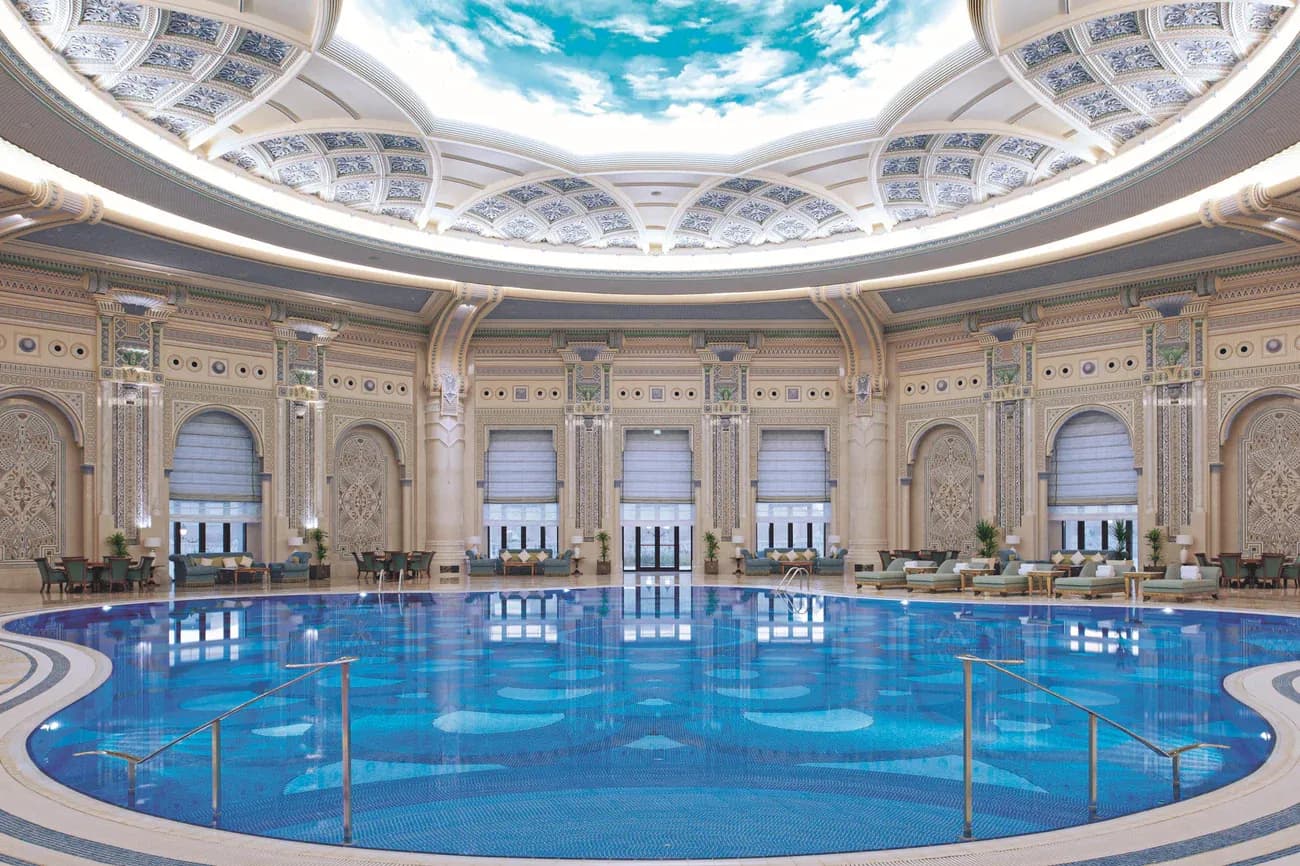
The Ritz-Carlton Riyadh is not a hotel that happens to have palatial grounds. It was built as a palace and then converted. The distinction matters: the scale of the corridors, the height of the ceilings, the proportion of the formal gardens, the imperious quality of the evening light across the main pool, none of these were designed for a hotel. They were designed for permanence, for ceremony, for the accommodation of heads of state. Which is precisely who stays here. The 493 rooms and suites represent the largest Ritz-Carlton property on earth; the seven restaurants include some of the finest dining in Riyadh; and the butler programme, one of the oldest established in the city, operates with a fluency that comes only from decades of practice.
Book The Ritz-Carlton, Riyadh
Check availabilityOr book direct with
We compare 3 sites at no cost. Same price as booking direct.
Skyline Luxury
Four Seasons Hotel Riyadh at Kingdom Centre
Kingdom Centre Tower, Riyadh
While the Ritz-Carlton offers the grandeur of a palace, the Four Seasons at Kingdom Centre offers something equally compelling: the finest views of any hotel in Saudi Arabia, from a position that doubles as one of Riyadh's defining architectural experiences. Floors 30 to 39 of the Kingdom Tower house 203 rooms and suites, each with floor-to-ceiling windows that survey the city from an elevation of approximately 150 metres. The spa is among the most accomplished in the Kingdom; the Al Orjowan restaurant serves contemporary Arabic cuisine at a level that draws Riyadh's most demanding residents; and the direct connection to the Sky Bridge observation deck ensures that the view, if you want it, is never more than a lift ride away.
Book Four Seasons Hotel Riyadh at Kingdom Centre
Check availabilityOr book direct with
We compare 4 sites at no cost. Same price as booking direct.
FAQs
Riyadh - Common Questions
What are the best luxury hotels in Riyadh?
The Ritz-Carlton Riyadh (palatial, formal, the original great address in the city) and the Four Seasons at Kingdom Centre (skyline views, contemporary luxury, exceptional dining). The choice comes down to a palace or an eyrie.
What is the Edge of the World?
Jebel Fihrayn, a natural escarpment 90 minutes from central Riyadh where the Tuwaiq Plateau drops hundreds of metres into an uninhabited valley. Among the most dramatic landscapes in the region, and completely unknown to most visitors. Sunset visits with private champagne service at the cliff edge are available through local operators.
What is Diriyah?
The birthplace of the Saudi state, a UNESCO World Heritage Site comprising the 18th-century mudbrick ruins of At-Turaif on the banks of Wadi Hanifah. Private evening tours, illuminated after dark, are among the most atmospheric heritage experiences in the Kingdom.
Is Riyadh good for luxury travel?
Increasingly and emphatically yes. The Ritz-Carlton and Four Seasons are among the best hotels in the Middle East. Diriyah, Al-Masmak, and the National Museum provide genuine cultural depth. The Edge of the World is extraordinary. And the city's restaurant and private dining scene has matured rapidly.
What is the best time of year to visit Riyadh?
October through April, 15–28°C, clear desert skies, and the most active cultural and social calendar. The winter months also see Riyadh Season, which brings international events, performances, and temporary installations across the city.
Can Riyadh be combined with AlUla?
Yes. This is the Kingdom's most intellectually rewarding combination. The National Museum in Riyadh contextualises the Nabataean civilisation; a private helicopter tour of Hegra the following day makes the civilisation tangible. A private charter between the two cities takes approximately one hour.